
Your Cooking + Baking Aesthetic
What Feeds Your Aesthetic?

I’m an encore career chef living in Oregon among the most beautiful vistas in the United States ~ and the most dedicated, creative food people.
I teach what I call applied recipe development to help readers create the aesthetic of living and cooking they want in their lives.
I use TASTE | Pacific Northwest to advocate for immersing ourselves fully in our own food locale, for using every cooking adventure as a learning-teaching experience, and for protecting the food and land resources that allow us all to thrive.
Refining Your Own Aesthetic
What is your personal aesthetic? Each of us has a personal aesthetic… our own appreciation of taste, patterns, beauty, food, style, culture, art, design, structure. It’s your signature way of seeing and shaping your world. Your aesthetic emerges as a pattern across all of them. You notice it about yourself.
Think about the aesthetics of food. The aromatics that rise through the nostrils before taste even begins. The pleasures of sweet, salty, bitter on different areas of the tongue. Savoring the texture, slowly, as you more fully enjoy the fabric of the dish, the flavor of which you’ve imagined ~ or remembered. Imagination and memory precede aromatics, taste and texture as food aesthetics. You remember a beloved family or restaurant dish.
Aesthetics as a Belief System
Preceding all of it are cultural and value influences ~ sustainability, nostalgia, rebellion, spirituality, simplicity. Perhaps, you have a gardener’s earthy aesthetic or a generational desire for sleek minimalism. Our own aesthetics affect ~ and drive ~ everything from computer font preferences to home decor to curated playlists.
Noticing Your Internal Compass
A Felt Method
Slowing down a bit to let those personal moments of self-awareness arise is a step to more fully enjoying your life. Little insights arise. A fragment of memory surfaces. It’s becoming more sensory-intelligent.
Less Attention to Result, More Attention to Process
Cooking and baking nudge us to notice textural shifts, aroma cues and moisture levels. Ingredients like all-purpose flour, bread flour, fine pastry flour, or “OO” flour have distinctive textures. Have you ever noticed how easy a fresh bag of flour is to work with? It’s tender, supple, and soft as you roll pasta or pastry, and it shows up in the finished dough. Flour has a kind of spectrum of behaviors dependent upon milling and freshness.
Applied Recipe Development
Encouragement as Teaching
Those of us who love food ~ or who are learning to love food ~ want to become better cooks. The method of becoming a better cook is teachable. That’s what we do at TASTE.
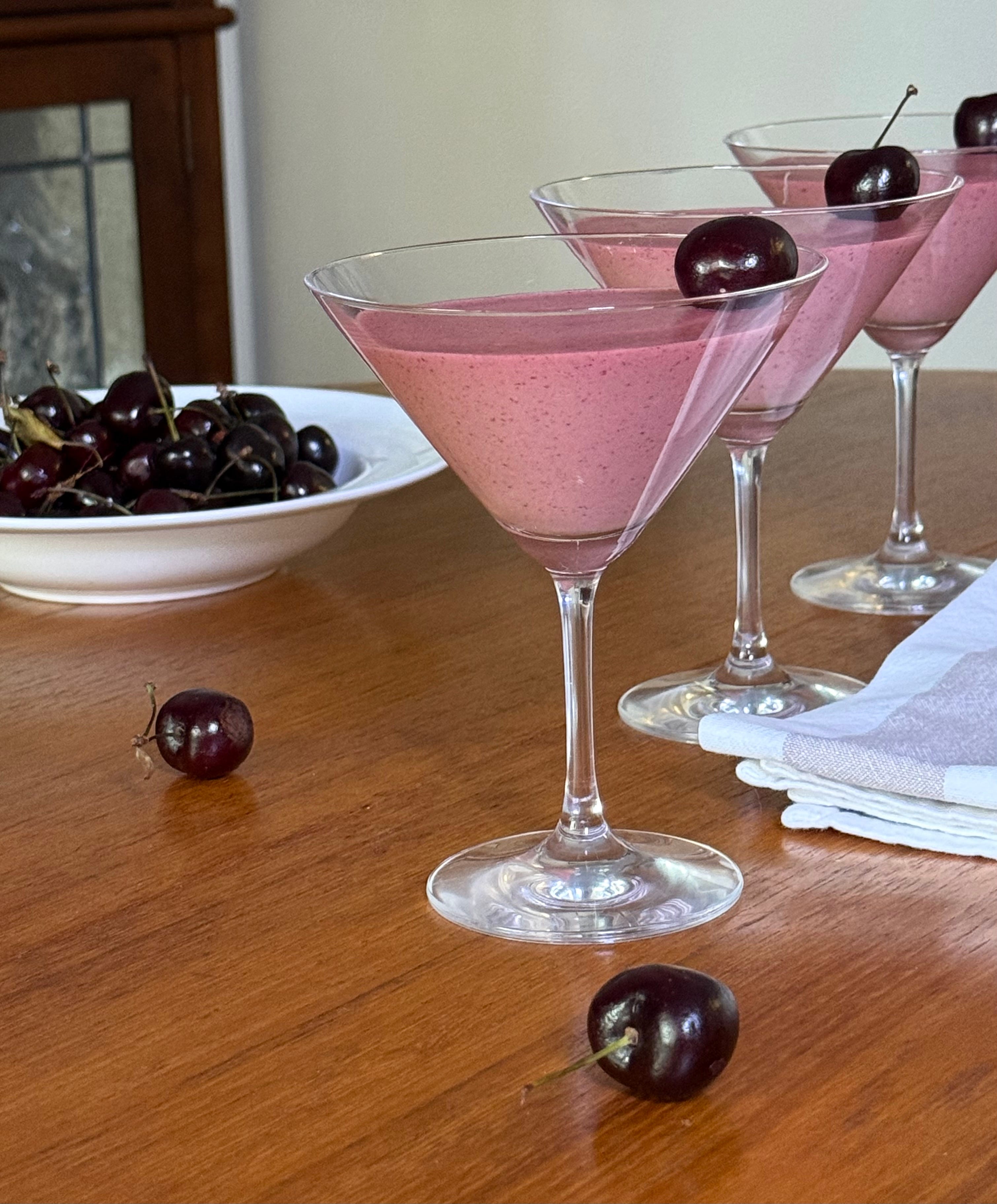
As encouragement, I’ll offer you a personal example of how learning works. In the U.S. Pacific Northwest and the Upper Midwest, early July is the start of cherry season. I wanted to make a dark cherry mousse.
Why use dark, sweet cherries? Intensely sweet Bing and Chelan dark cherries are preferred for cooking and baking. We happen to live in the Pacific Northwest where 70% of the nation’s dark cherries are grown. Conversely, Balaton dark cherries, smaller, sour and tart, are primarily grown in Michigan (smaller still are Montmorency, grown in Oregon). Both categories are available nationally.
Beautiful yellow cherries like Rainier (with a pink-to-red blush) and Queen Anne (yellow to creamy white with pink shoulders) have a lighter, more delicate flavor and are ’eating’ cherries to be consumed while fresh. Grab them at market as soon as you can!
I Made an Assumption
A strawberry-cassis mousse recipe I used when baking professionally seemed like a good model. Why the recipe didn’t have a yield (the number of servings or finished weight), I cannot explain. (That should have been a sign.)
I incorrectly assumed I could use similar weights of fruit. The trouble was that in-season strawberries are more naturally sweet than cherries (which I hadn’t accounted for) so I assumed the cherries needed a similar level of sugar. Why was using less sugar in the cherry mousse a problem? Sugar is the preeminent flavor enhancer and I was about to under-utilize it because of a flawed assumption.
My restaurant notes very poorly described the amount of strawberry juice the berries would yield when crushed and pressed, which created the next problem: How much gelatin would I need to set the mousse? In my first test batch, I added more than I needed which produced mousse that was a bit too thick and slightly rubbery. Ugh.
The strawberry mousse recipe called for the berries to be macerated (adding sugar and allowing them to sit for 45 minutes to extract the juice). I discovered (the hard way) that cherries don’t benefit from maceration. I eliminated that step.
In two separate test batches, I had forgotten that similar textures and similar temperatures combine easily; dissimilar textures and temperatures do not. After reducing to distill flavor, I cooled the mixture only to room temperature (including the added softened and dissolved gelatin), instead of cooling then combining with the juice that was already in an ice bath. Because the combined juice mixture wasn’t cold or thick enough, the result was that part of the combined juice didn’t incorporate with the whipped cream, and settled to the bottom of the martini glass. Twice. That wasn’t a gelatin problem; it was process problem.
Paul Caloca and I critically tasted each batch for everything we cared about; I made changes accordingly. When I was ready to prep the third time, I reviewed every assumption, every calculation. Then I researched numerous sources on the amount of gelatin recommended for my desired end result. (I used packaged granulated gelatin instead of gelatin sheets because it’s a bit more common in everyday use.)
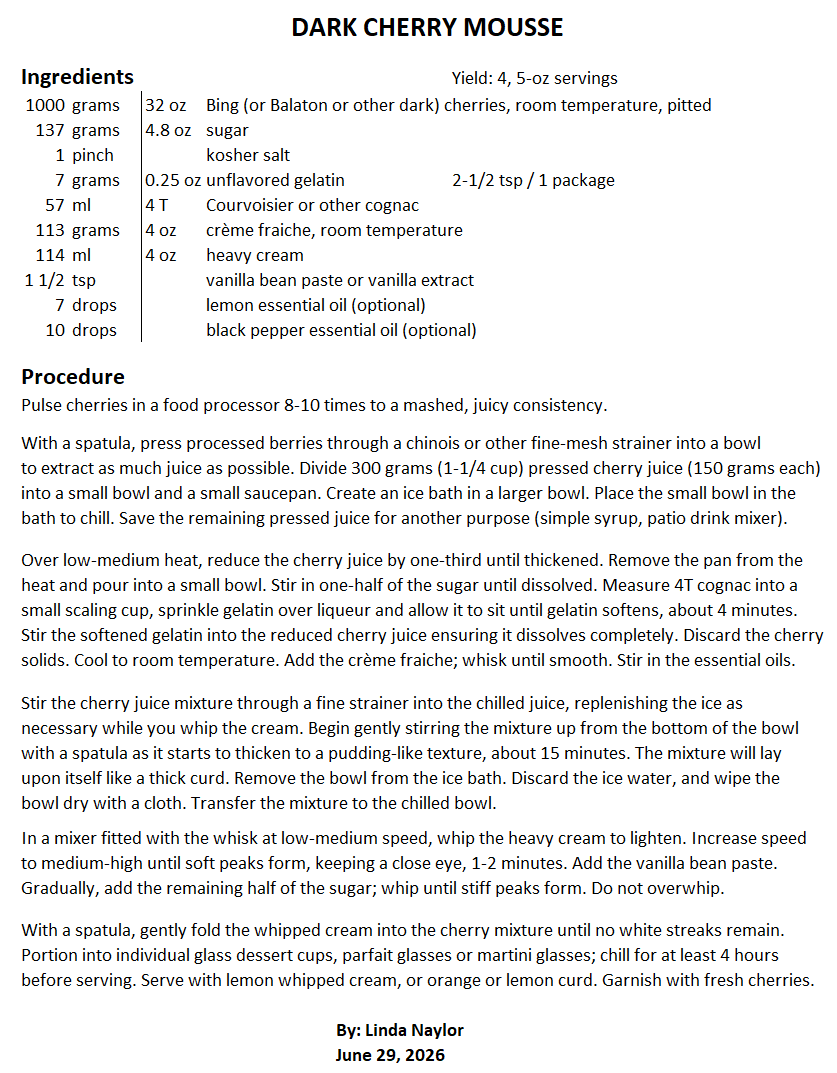
The typical standard is a ratio of 1% of gelatin to the total weight of the ingredients. The total net weight of my ingredients in grams was 721 grams x .01 = 7 grams (721 rounded down to 700), or 1 package of unflavored gelatin. [300 grams juice, 137 g sugar, 57 g cognac, 113 g creme fraiche, and 114 g heavy cream).
If I can again strongly encourage you to weigh your ingredients in grams, your confidence to cook and bake will increase exponentially.
Epilogue
No cook or baker or chef is without the desire to inquire, to question, to improve. All the flaws in thinking and poor assumptions I described to you are part of learning. Testing and questioning are naturally the way I work. You will have your own methods as you gain confidence.
You create your own food aesthetic. I’m here to guide you.
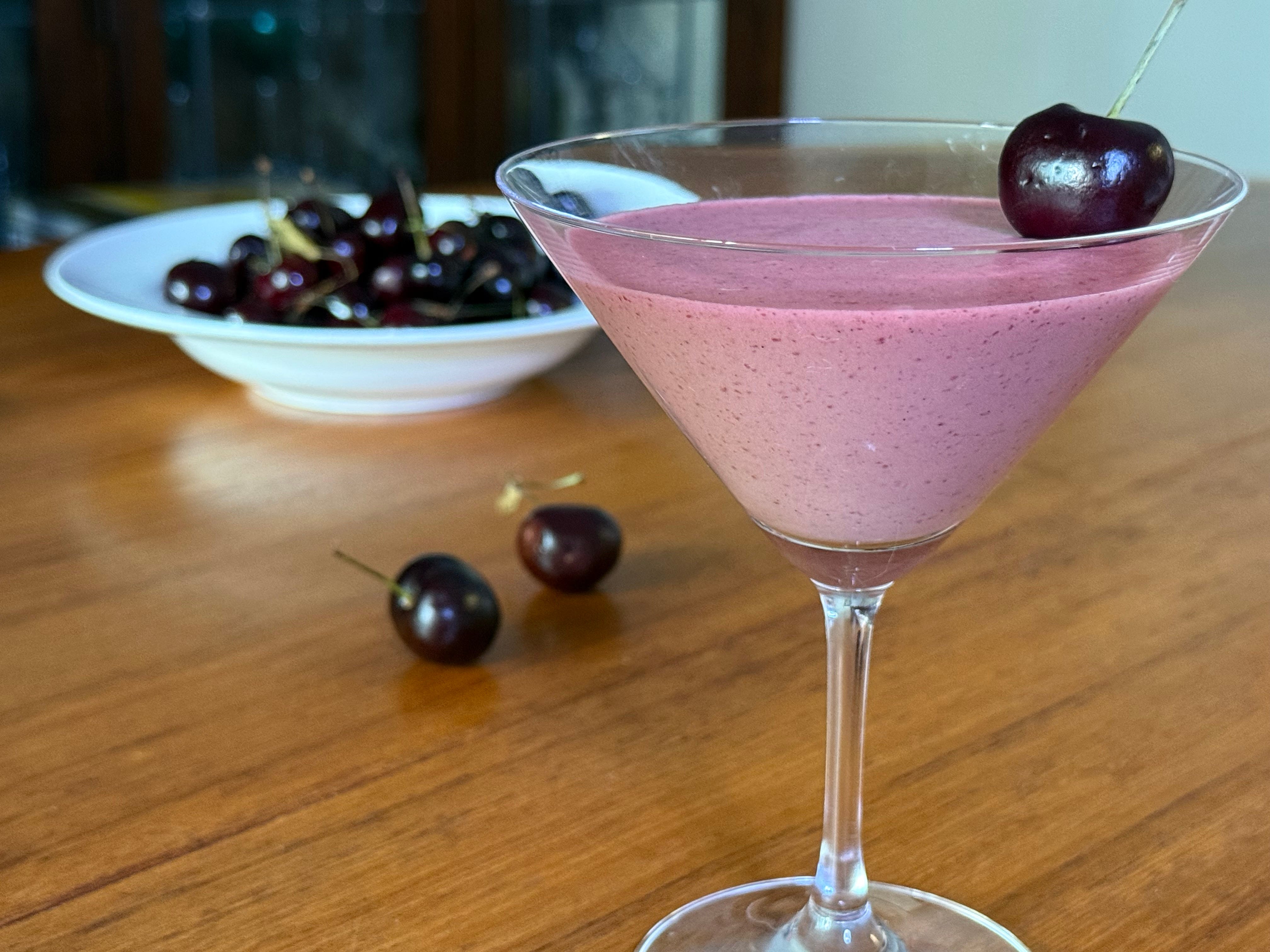
The flavor affinities for cherries are (MANY!): almonds, amaretto, apricots, Armagnac, bourbon, brandy, butter (unsalted), buttermilk, caramel, cassis, cheese (Brie, goat, ricotta), chocolate (dark, white), cinnamon, cloves, cognac, cream, cream cheese, creme fraiche, custard, espresso, figs, ginger, hazelnuts, honey, Kirsch, lemon (juice, zest), lime (juice), liqueur (almond, orange), mascarpone, nectarines, nuts, orange (juice, zest), peaches, pecans, pepper (black, green), pistachios, plums, port, raspberries, rose hips, rum, sage, stocks, sugar, vanilla, vermouth (sweet), vinegar (balsamic, ice wine, red wine), vodka, walnuts, wine (dry red, sparkl Champagne, yogurt. WHEW!
Dark Sweet Cherry Mousse
Headnotes
I can’t encourage you more sincerely to make this mousse this summer. It has every luxe quality a gorgeous mousse needs: rich cherry flavor, a polished glass texture, and aromatic and background notes of lemon and black pepper, should you choose to use the essential oils. (Remember, the F.D.A. has a list of essential oils (what it calls GRAS or Generally Recommended as Safe) for use in food prep and production.) I love using them; however, they’ll always be optional.
Use whatever complementary affinity flavor (or none) from the list above that you prefer.
There’s a moment at the end of research and testing when it all comes together. Tasting this mousse with a spoon, slowly savoring the perfect taste, texture and fragrance, is an eyes-closed moment. That’s how you enrich your own life and the lives of others.
Three iterations… that’s what it took… so the simplicity of the finished mousse matches its elegance.
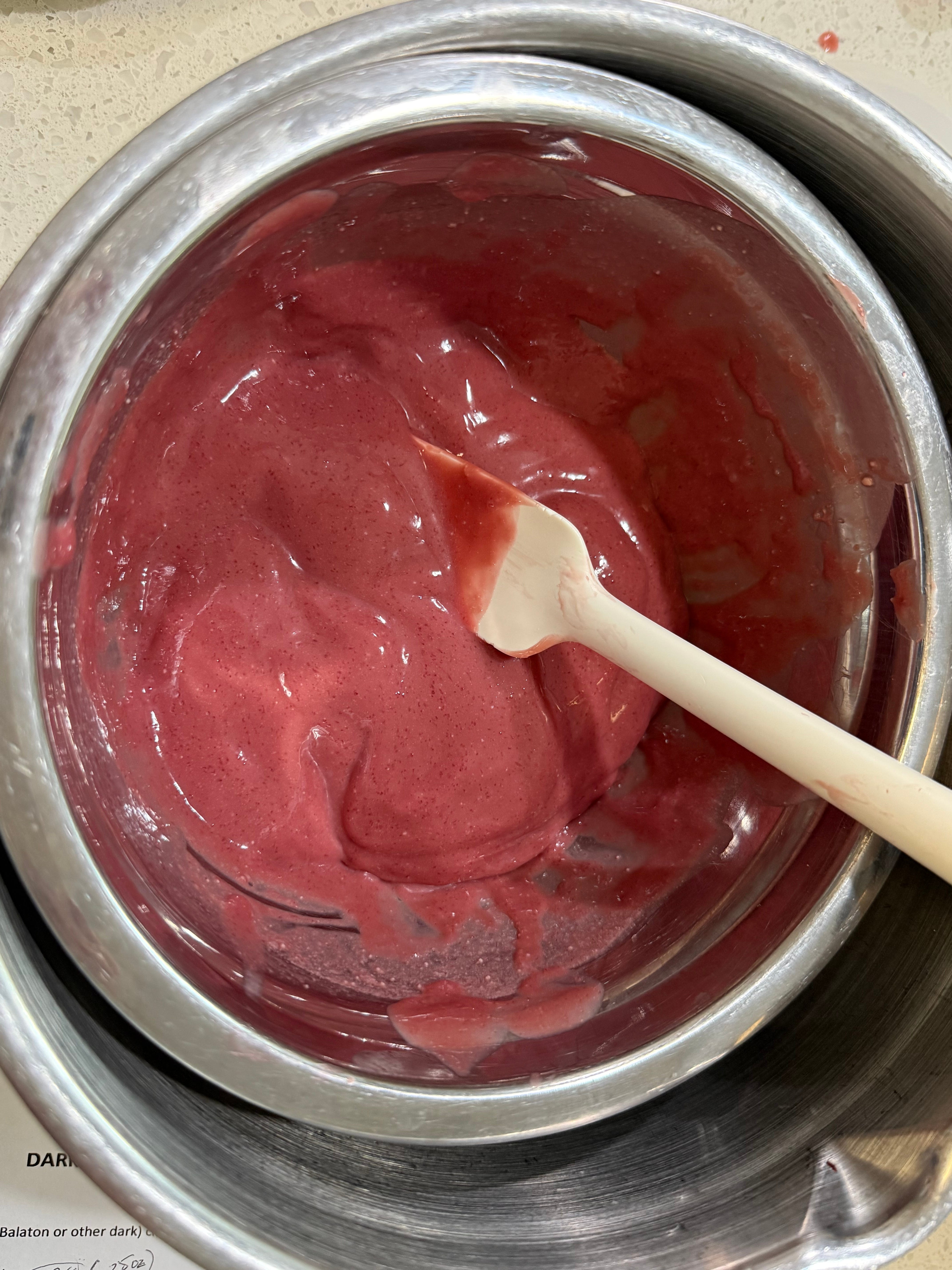
Chilling the cherry juice in an ice bath, and spending a few extra moments to allow the gelatinized mixture to thicken, make folding in the cushy whipped cream a breeze.
TASTE has gratitude for every subscriber. Our particular thanks to our paid subscribers, our TASTE Buds, whose generosity supports every reader.
Every TASTE | Pacific Northwest post is human-created: personally written, personally read to you.
Likes, Comments and Restacks are highly prized! Please click on the ❤️ icon to let the algorithm know our work is worth supporting.
If you enjoy learning how to coax out flavor; if you feel inspired to protect the beautiful food environment around you; if you enjoy more personal essay, you’re very welcome to push the Subscribe button.
Perhaps, even share with a friend. It’s nice to share.
A note. Our use of a tilde (~) in text is an homage to the brilliance of Judy Rodgers’ The Zuni Cafe Cookbook. The em dash (—) and the colon (:) are mine alone. Please never mistake them for AI.